How to trade meme coins with just $10 and keep fees from eating the whole position
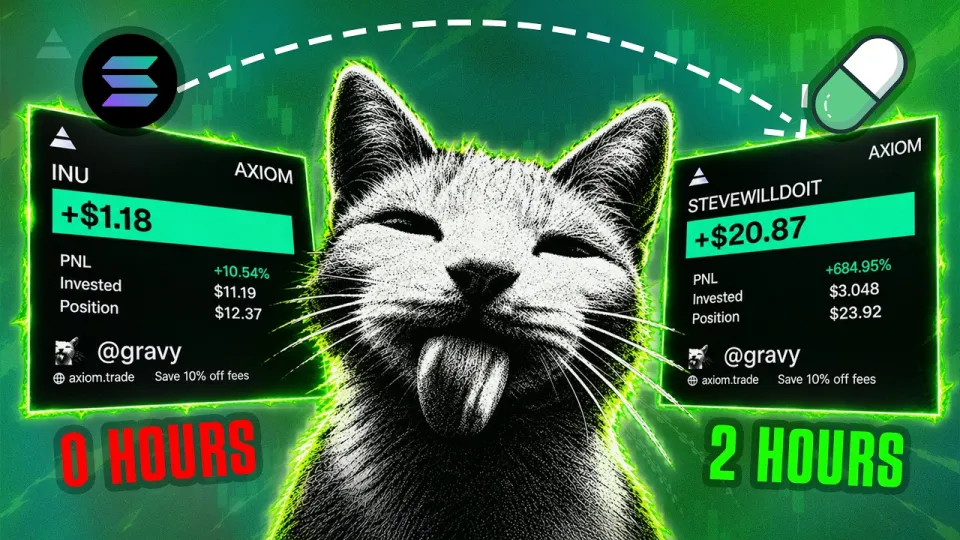
Video: I Tried Trading Memecoins with Just $10
Want articles like this for your own video to promote it on YouTube and Google? Order them through the Telegram bot @sat_sit_bot. The bot writes and publishes the articles itself (with your YouTube video embedded) on popular topical websites (no ads). Try it free: 50 articles on us.
· based on the channel gravy
You can trade meme coins with $10, but only if you treat fees and position size as the strategy rather than an afterthought. A $10 account on Solana survives on sub-0.05 SOL buys, fast exits and a narrative you can explain in one sentence; it dies on 2% round-trip costs and slow hands. The clearest recent demonstration is the «gravy» channel's five-trade experiment, which used Axiom for Solana trading with referral cashback and never let a single buy exceed 0.05 SOL.
What a $10 meme coin experiment actually looks like
The premise of trading meme coins with a small portfolio is simple: use a balance small enough that a total loss changes nothing, but size each position so fees stay a rounding error. In the gravy run, that meant five separate trades on Solana tokens, each entry capped at 0.05 SOL, with the reasoning for every buy and sell walked through afterwards. A 0.05 SOL buy at roughly $200 per SOL is about $10, so the cap keeps the whole account in one position at a time rather than splitting into dust.
The tickers were STEVEWILLDOIT, NPC, MET (Meteora), PUMPY the Trader and UNTXD. That mix matters: two are pure meme plays, MET leans on a real protocol name, and PUMPY and UNTXD are the kind of low-cap launches that only exist for a few hours. The video's own framing is honest about the outcome — one of the five is described as a hard fumble, which is a more useful data point than a clean sweep.
The fee math that decides whether $10 is viable
Fees, not the starting balance, are the real constraint on small-portfolio meme coin trading. Every Solana swap carries a network fee, a priority fee, pool or platform charges, and slippage on the way in and out; on a thin new token the slippage line is usually bigger than everything else combined. If a round trip costs you 5–10% of the position, a $10 trade needs a 10% move just to break even.
A practical checklist before any $10 buy:
- Check the pool's liquidity. If your $10 order moves the price more than a percent or two, the token is too thin.
- Set slippage manually. Defaults of 10–20% on new launches hand away most of the edge.
- Use a router or terminal that rebates fees, since a referral or cashback rate directly improves your break-even.
- Count the exit before the entry. Two swaps, not one, is the cost you are actually paying.
- Keep gas in reserve. A wallet with exactly 0.05 SOL and nothing else cannot sell when it needs to.
On a $10 account the difference between a 1% and a 5% round trip is the difference between a strategy and a donation.
Why narrative, not chart patterns, drives these trades
The X Money meta is the clearest example of how a story moves a meme coin faster than any technical setup. The video ties the run to the e/acc crowd and to Cream, the kind of loose cultural association that gives traders a reason to buy within minutes of a launch. Meme coins have no cash flows, so the only thing that can reprice them is attention, and attention clusters around names people already recognise.
That has two consequences for a small account. First, the entry window is short: by the time a narrative is explainable to a newcomer, the first leg is usually done. Second, the same narrative can be recycled across several tickers, and only one of them tends to hold the liquidity. STEVEWILLDOIT and NPC both sit in that category of internet-culture names where the joke is the product.
Position sizing rules for a low balance account
Sizing is the only risk control a $10 trader really has, because stop losses on illiquid meme coins slip far past where you place them. The 0.05 SOL ceiling used in the experiment works as a hard rule: one position at a time, no averaging down, and no adding to a loser because the story still sounds good.
A workable structure for a balance this small:
- Cap any single buy at the full balance and accept that a zero is possible.
- Take partial profit on the first strong impulse instead of waiting for a round number.
- Exit fully if the thesis breaks, even at a 20–40% loss, rather than hoping for a bounce.
- Log every trade with entry, exit and reason, because five trades is not a sample but fifty is.
The hardest part is not the size, it is the discipline: a $10 loss feels trivial, which is exactly why small accounts overtrade and bleed out through fees.
Where small meme coin traders actually lose money
The most common failure is buying a dip in a coin whose narrative has already peaked. Traders describe finding a token with a good story, buying the pullback, watching everyone else sell into it, then exiting at a 20–40% loss just before it runs higher without them. That pattern is a timing problem, not a knowledge problem: the dip was the distribution, and the later run was a different cohort of buyers.
A second failure is information overload. Tracking every tweet, remembering which accounts still have influence, and judging whether a community is real is a full-time job, and it is the reason many people default to buying whatever is trending. The fix is to narrow the watchlist to one or two ecosystems and a handful of accounts, and to skip anything you cannot explain in a sentence.
A third is tooling. Terminals and routers differ in fees, execution speed and how they surface new pairs, and a small account feels every basis point. This is also where the referral economics matter: a cashback rate on fees is a direct subsidy to a $10 trader, which is why the experiment routes orders through a single terminal rather than several.
What the five trades teach about expectations
Five trades prove nothing statistically, and the video does not pretend otherwise; it is a process demonstration, not a track record. What it does show is that a sub-0.05 SOL buy can be executed, managed and exited without the fees swallowing the position, provided the token has enough liquidity and the trader is willing to sell quickly. It also shows the cost of one bad decision: a single fumble can wipe out the gains from several good calls when the position size is the entire account.
The realistic goal for a $10 meme coin account is not turning it into rent money. It is building a repeatable routine — narrative check, liquidity check, fee check, exit plan — that can be scaled later. Anyone who cannot stay disciplined with $10 will not stay disciplined with $1,000.
Useful links
- Axiom trading terminal with referral cashback — the terminal used for the trades
- https://discord.gg/W7TqkExcSd — The Trenches Discord
- https://discord.gg/9W5j3XUgYB — Discord with free Axiom imports and trade signals (not financial advice)
- https://x.com/gravyski — the trader's X account
- https://www.bitbase.com/landing-page/trading-earning-Gra?ref=8CYOGY — leveraged trading with a 20% futures fee reduction
Bottom line
Trading meme coins with $10 is possible on Solana, but the balance is not the limiting factor — fees, slippage and discipline are. The gravy experiment shows a workable template: cap each buy at 0.05 SOL, trade one narrative at a time, use a terminal with fee cashback, and treat one fumble as the cost of learning rather than a reason to double down. Scale the routine, not the position size, and the small account becomes a cheap training ground instead of a slow drain. For anyone who wants to follow the same process, the channel «gravy» is worth watching for its trade-by-trade breakdowns, and the Axiom referral link is where the execution side starts.
Key takeaways
- Five real trades, each buy kept under 0.05 SOL, run through Axiom on Solana
- Tickers traded: STEVEWILLDOIT, NPC, MET (Meteora), PUMPY the Trader and UNTXD
- The X Money meta (e/acc, Cream) is cited as the narrative driver behind one of the entries
- Fees and slippage, not the small balance, are what break a $10 meme coin account
- The trader openly flags one of the five trades as a fumble rather than a win
Source: I Tried Trading Memecoins with Just $10 · Markdown version
Questions & answers
Can you really trade meme coins with only $10?
Yes, on a low-fee chain like Solana, as long as each buy is small enough that fees and slippage stay a minor share of the position. The $10 experiment kept every entry under 0.05 SOL and still executed five separate trades. The catch is that a single bad exit can erase several good ones, so the balance is a training size rather than an income.
How much do fees and slippage eat on a small meme coin trade?
A round trip involves two swaps, network and priority fees, platform charges and price impact, and on thin new tokens the slippage line usually dominates. If the total round trip costs 5–10%, a $10 position needs a double-digit gain just to break even. Setting slippage manually and using a terminal with fee cashback are the two easiest ways to shrink that number.
Why do meme coins pump on narratives like the X Money meta?
Meme coins have no cash flows, so price is driven by attention, and attention clusters around names and stories people already recognise. The X Money meta, tied to the e/acc crowd and Cream, gave traders a shared reason to buy within minutes of launch. The trade-off is speed: by the time a narrative is widely understood, the first move is usually over.
How do you avoid buying a dip that never recovers?
Assume a dip after a strong first leg is distribution until proven otherwise, and require a fresh catalyst before re-entering. Traders who buy the pullback often sell at a 20–40% loss only to watch the coin run later without them, which usually means the second run had different buyers. Capping position size and logging every trade makes that pattern visible before it becomes expensive.